
There’s No Margin of Safety When You Buy Using Leverage
Buying stock on margin occurs when you borrow money to purchase securities. It’s called leverage because it magnifies your results in both directions.
Warren Buffett has said “if you’re smart, you don’t need it; if you’re dumb, you shouldn’t use it.”
For example, imagine you have $100,000 of your own money to invest but you also borrow $50,000, giving you a $150,000 total portfolio:
- The Upside (2021): If your portfolio matched the S&P 500’s +28.7% return in year 2021, your total portfolio grew by $43,050. Measured against your original $100,000, that’s a +43.1% return. (Note: there’s also an interest expense [usually Prime + 3 to 6%] that gets debited from your portfolio each month).
- The Downside (2022): If you tried the same strategy the next year in 2022 when the S&P 500 fell 18.1%, your $150,000 portfolio lost $27,150. On your initial $100,000, you’re down 27.2%, a loss significantly worse than the broader market’s decline. The losses are even worse after including the interest expense, which climbed throughout 2022 as central banks hiked the cost of borrowing. At an 8% interest rate, you lost another $4,000 after borrowing the $50,000.
Despite this obvious risk, professional money managers can often be their own worst enemy. We saw the effect of leverage gone wrong play out yet again just last month.
Situational Awareness’ Forced Liquidation in July 2026
Late last month, hedge fund Situational Awareness faced margin calls. It was levered 4-to-1, meaning it held $4 in total assets for every $1 in capital. This meant that just a 25% pullback in their investments would wipe out their entire equity. It was invested in stocks mostly related to the AI trade, and when prices pulled back, Situational Awareness faced margin calls as banks demanded additional collateral to stand behind their loans. That made Situational Awareness a forced seller. Citadel Securities bought their equity portfolio (at a 10% discount). Its fund was down 67% in July, though the Nasdaq had fallen by only 3.2%.
This isn’t unprecedented.
Even Nobel Laureates Couldn’t Escape the Risks of Leverage
Long-Term Capital Management was a hedge fund run by Nobel laureates in the 1990s that used extreme leverage. The fund borrowed over $125 billion on a $5 billion capital base (a 25:1 ratio) to magnify tiny price differences in bond markets. However, when the 1998 Russian financial crisis triggered unexpected market volatility, those minor misalignments turned into massive losses, wiping out $4.6 billion in equity in less than four months, prompting the Federal Reserve to intervene.
Warren Buffett’s take on Long-Term Capital was:
[Those 16 people had in aggregate] 350 or 400 years of experience doing exactly what they were doing. … Most of them had virtually all their very substantial net worths in the business. So they had their own money up… super high intellect, working in a field they knew, and essentially they went broke. To make money they didn’t have and didn’t need, they risked what they did have and did need. That is foolish. That is just plain foolish.
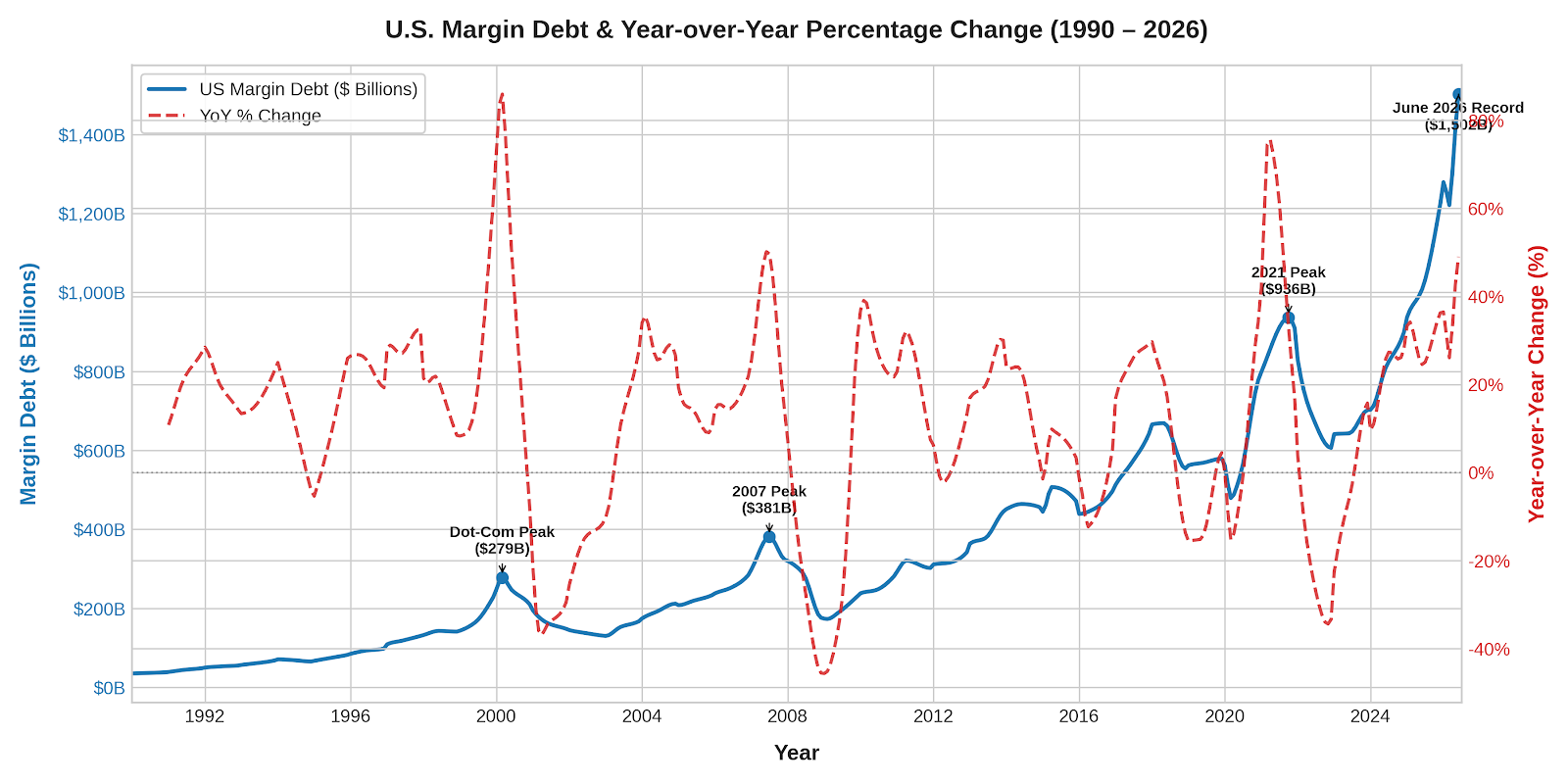
Margin Debt is at a Record High Today
Last week, we cited the rise of margin debt to be a major concern we have with this market. As of June 2026, there was over $1.5 trillion outstanding in margin debt, roughly 49% higher than the year before.
In March 2000, right at the peak of the dot-com bubble, margin debt was up 82.5% year-over-year. In July 2007, margin debt was up almost 46% compared to the year before.
Why We Don’t Use Margin for Clients
We don’t employ leverage for any of our clients. People often overestimate their risk profile in a questionnaire only to discover it is much less whenever a market correction occurs. If someone asked us to buy on margin, we likely wouldn’t do it. Instead, we construct diversified portfolios that include several dozen securities for each client in order to manage risk and volatility.
Compounding wealth requires capturing the upside when times are good but also surviving the downside when times are bad.
-written by Jeff Pollock
DISCLAIMER: The opinions expressed in this publication are for general informational purposes only and are not intended to represent specific advice. All publications have been written by a person other than the person that approved its distribution. No compensation has been received from any party to promote or publish this content. The views reflected in this publication are subject to change at any time without notice. Every effort has been made to ensure that the material in this publication is accurate at the time of its posting. However, Schneider & Pollock Wealth Management Inc. will not be held liable under any circumstances to you or any other person for loss or damages caused by reliance on information contained in this publication. You should not use this publication to make any financial decisions and should seek professional advice from someone who is legally authorized to provide investment advice after making an informed suitability assessment.