
Should You Expect Astronomical Returns From SpaceX?
SpaceX shares made their long anticipated debut to the public market on Friday, June 12.
The demand was unprecedented. Not only was it the largest offering in history after raising over $75 billion, but brokerage firm Charles Schwab also said it was the fifth most active day in their company’s 50-year history.
SpaceX’s pre-open price was set at $135 per share, but the stock climbed to open at $150 per share. Two trading days later, the stock reached $225.64 intraday, though it has since pulled back by over 30% to $153 per share as of today.
Expectations for SpaceX’s future are high, to put it mildly. Not unlike Tesla, which trades at a valuation incomparable with other automakers, SpaceX trades at a lofty 100x revenue multiple (by comparison, Alphabet [formerly Google] trades at 10x revenue).
Clearly, the investors betting on Elon Musk are willing to pay an astronomical premium.
Now that the bets are in, where might the SpaceX stock go from here?
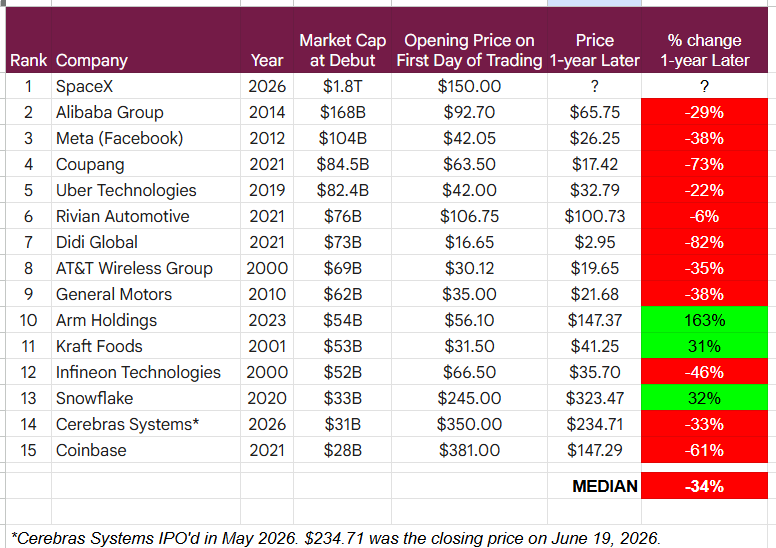
Looking at the one-year price performance of the 15 largest stocks to go public since 2000 paints a disappointing picture.
In fact, the median price return one-year after a new company begins trading was found to be -34%.
A full 12 out of 15 stocks traded lower, and only 3 companies (Arm Holdings, Kraft Foods, and Snowflake) finished the year higher than its opening price on the first day of trading.
Some of the stocks that were down a year later are household names, such as Meta, formerly known as Facebook (-28%), Uber (-22%), AT&T Wireless (-35%), and General Motors (-38%).
There is some logic as to why stocks sell off after their debut to the public market.
First, many companies wait for favourable market conditions to list their shares. This means rich valuation multiples fueled by investor optimism. In other words, classic “animal spirits”. After all, they are selling their business to shareholders. Who wouldn’t want to sell for the highest price possible?
Second, overly enthusiastic buyers are often the first to jump on board before they believe it’s too late. This optimism drives the stock price higher, at least at first. Then, as a new public company undertakes the grueling process of reporting quarterly earnings, hosting regular conference calls, filing material change reports, and adhering to blackout periods, reality sets in, and the stock price drifts toward a more realistic valuation.
Third, when a company goes public, its insiders (such as the founders and employees) are legally restricted from selling their shares for several months. Once this lock-up period expires, employees who have long dreamed of a big house or a fancy car may sell to raise cash, while others may simply want to diversify out of a single stock. SpaceX’s staggered lockup lifts for early investors on June 29, followed by company insiders on August 11.
Evidence suggests that it is almost always better to wait than to buy into new companies that trade above their first opening price. For this reason, we don’t invest in securities immediately after their initial public offering, nor would we buy SpaceX in the near future.
(Disclosure: Clients, Jeff Pollock, and Sunni Schneider have a financial interest in Alphabet as shareholders, but do not have a financial interest in any other company mentioned in this blog. No compensation was received to publish this content.)
-written by Jeff Pollock
DISCLAIMER: The opinions expressed in this publication are for general informational purposes only and are not intended to represent specific advice. All publications have been written by a person other than the person that approved its distribution. No compensation has been received from any party to promote or publish this content. The views reflected in this publication are subject to change at any time without notice. Every effort has been made to ensure that the material in this publication is accurate at the time of its posting. However, Schneider & Pollock Wealth Management Inc. will not be held liable under any circumstances to you or any other person for loss or damages caused by reliance on information contained in this publication. You should not use this publication to make any financial decisions and should seek professional advice from someone who is legally authorized to provide investment advice after making an informed suitability assessment.