
Does a Technical Recession in Canada Mean Sell Your Stocks?
Economists define a “technical recession” as two consecutive quarters of negative economic growth.
After shrinking by 1.0% in the final quarter of 2025, the economy dipped an additional 0.1% in the first quarter of 2026. This latest contraction is minor, and it is a preliminary figure that will likely be revised upward or downward in future economic reports.
Nevertheless, by that definition, Canada is in a technical recession.
However, this is no reason to sell your Canadian equities. The stock market is forward-looking, constantly pricing in future expectations rather than yesterday’s headlines. It isn’t always efficient, frequently overreacting to or underestimating events, but the market generally prices in economic shifts well before they actually materialize.
The 2008 financial crisis is a good example. The S&P/TSX Composite Index bottomed on March 6, 2009, at 7,480 points, while Canada’s unemployment rate sat at 8.1%. By the time unemployment actually peaked at 8.7% that August, the market had already rallied more than 45% from its low. We saw the same pattern on the way down, too. When the Bank of Canada officially declared a recession on December 9, 2008, the TSX had already plummeted 39% since Labour Day.
So, Canada hit a technical recession. At least it did, but that may not be the case anymore.
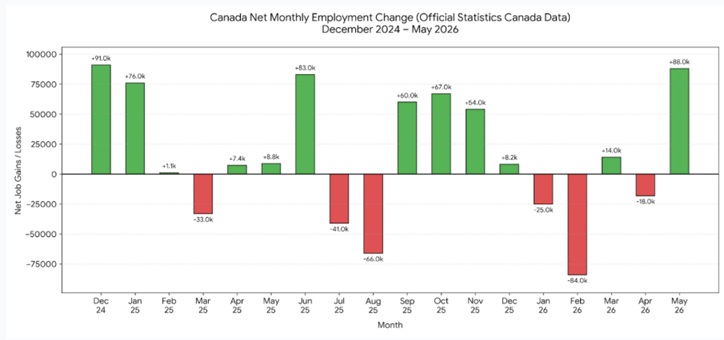
On Friday, data on the jobs added to the economy last month were released. It was a strong report, to say the least. Canada added 87,800 jobs in May, causing the unemployment rate to fall down to 6.6% (down from 6.9% in April). To put that into perspective, 80% of the jobs lost since the start of the year were erased by this one strong month.
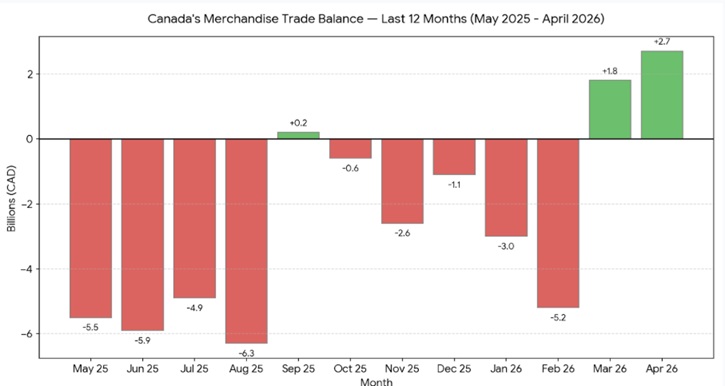
Strong energy prices caused by the war in Iran have also provided Canada with a trade surplus the last two months. In other words, exports sent to other countries exceeded what we imported by $1.8 billion in March and $2.7 billion in April. This will boost our economic growth, especially this quarter.
The major weight on our economy is the trade uncertainty that has caused businesses to pause investment. With CUSMA up for review this July, we expect there to eventually be some kind of agreement. U.S. midterms take place in the fall, and over 30 states count Canada as their largest international customer.
We don’t believe Canada is in a recession, at least not at the moment with strong energy prices and job gains. But even if it were, the market lives in the future and the better option is to stay invested when concerned about yesterday’s headlines.
-written by Jeff Pollock
DISCLAIMER: The opinions expressed in this publication are for general informational purposes only and are not intended to represent specific advice. All publications have been written by a person other than the person that approved its distribution. No compensation has been received from any party to promote or publish this content. The views reflected in this publication are subject to change at any time without notice. Every effort has been made to ensure that the material in this publication is accurate at the time of its posting. However, Schneider & Pollock Wealth Management Inc. will not be held liable under any circumstances to you or any other person for loss or damages caused by reliance on information contained in this publication. You should not use this publication to make any financial decisions and should seek professional advice from someone who is legally authorized to provide investment advice after making an informed suitability assessment.