
Don’t Blow Up Your Portfolio During Times of War
Geopolitical uncertainty is a frequent companion to market selloffs, primarily because the market tends to despise surprises and prolonged instability.
However, taking a historical perspective reveals that while no one desires the outbreak of war, it is rarely a sound reason to sell off your portfolio.
We always tell clients that if their portfolio grows by 7% per year, they will double their money every decade. If 100% over 10 years is a reasonable metric to use, the market has outperformed this benchmark every single time there has been a major military conflict involving the U.S.
Data tracking the ten years following the breakout of U.S.-involved wars shows significant gains, ranging from a 108% return following the 1961 Bay of Pigs Invasion to a staggering 461% return following the 1990 Gulf War.
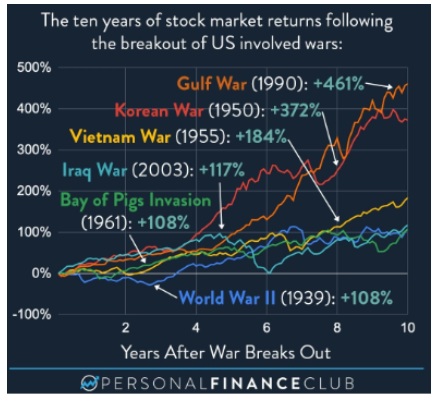
- Gulf War (1990): +461%
- Korean War (1950): +372%
- Vietnam War (1955): +184%
- Iraq War (2003): +117%
- Bay of Pigs Invasion (1961): +108%
- World War II (1939): +108%
Recent U.S. military actions against Venezuela and Iran have had a significant impact on global oil prices.
Operation Absolute Resolve, the U.S. strike against Venezuela, occurred in the early hours of Saturday, January 3, 2026. On the Friday immediately preceding that strike, West Texas Intermediate (WTI) crude oil closed at $64.50 per barrel. This was followed by Operation Epic Fury, a joint U.S.-Israeli military operation against Iran that began on Saturday, February 28, 2026. Just before those strikes, WTI crude was trading at about $70.00 per barrel.
The volatility reached a peak on Monday, March 9, 2026, when WTI crude hit an intraday high of $113.41 per barrel. While prices have cooled since that spike—with WTI currently trading at approximately $95 a barrel—the impact on energy-sector equities has been substantial.
For instance, Suncor was trading at $62.13 at the time of the Venezuela strike and has since risen almost 35% to $84.29. Similarly, Freehold Royalties, which was valued at $15.09 after accounting for dividends, has climbed by 15% to $17.43. Alongside these holdings, our clients continue to maintain positions in pipelines to capitalize on these shifting energy dynamics. (Disclosure: Clients, Jeff Pollock, and Sunni Schneider have a financial interest in Suncor and Freehold Royalties. No financial compensation has been given from either issuer for this blog).
Like all geopolitical conflicts in the past, we view this recent selloff as a buying opportunity.
-written by Jeff Pollock
DISCLAIMER: The opinions expressed in this publication are for general informational purposes only and are not intended to represent specific advice. All publications have been written by a person other than the person that approved its distribution. The views reflected in this publication are subject to change at any time without notice. Every effort has been made to ensure that the material in this publication is accurate at the time of its posting. However, Schneider & Pollock Wealth Management Inc. will not be held liable under any circumstances to you or any other person for loss or damages caused by reliance of information contained in this publication. You should not use this publication to make any financial decisions and should seek professional advice from someone who is legally authorized to provide investment advice after making an informed suitability assessment.