
Does the Crude Awakening in Oil Prices Still Make Suncor a Buy?
Even after the Strait of Hormuz eventually reopens and Iranian tensions ease, it’s doubtful that the West Texas Intermediate (“WTI”) oil price will decline to its pre-strike level of $65. Instead, we expect today’s $98 price to settle in the $80–90 per barrel range.
There are several reasons why we expect a higher floor for oil prices.
First, there’s a new risk premium now that we’ve seen the Strait of Hormuz can actually be shut down. Few thought this would happen, as the waterway accounts for 20% of global energy flow daily. Maritime insurance costs will likely escalate, and global refineries will shift toward just-in-case inventory management to ensure plenty of reserves in the event of a future shutdown.
Second, reopening the waterway does not guarantee an immediate return to full capacity. Conflict has caused physical damage to processing facilities and export terminals. Many estimate it could take several months—or even over a year—to restore full production levels, keeping the global supply-and-demand balance tighter than it was before the crisis.
This environment directly benefits our clients who are shareholders of Suncor Energy. We first bought the stock in December 2022 for about $41 per share. Since then, clients have received $6.62 in dividends. Today, the stock trades around $88, implying a total return of about 130%. (Disclosure: Sunni Schneider and Jeff Pollock have a financial interest in Suncor as shareholders but have not received any compensation for this blog.)
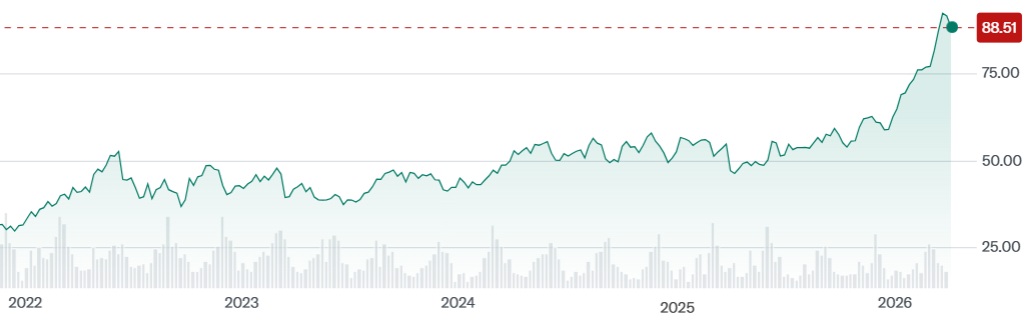
For years, Suncor traded at a perpetual discount following its Petro-Canada acquisition in 2009. Only recently has the stock finally broken out.
CEO Rich Kruger has been a breath of fresh air since joining the company in 2023, notably completing his three-year efficiency plan in just two. A cornerstone of this strategy was reducing the company’s WTI breakeven cost by $10 per barrel; Kruger now targets an additional $5 per barrel in savings by 2028.
The most compelling part of the Suncor story is its conservative guidance. The company expects to increase its free funds flow by 20% (or $2 billion) between 2026 and 2028 based on an assumed WTI price of $65. Because we expect WTI to settle between $80–90 a barrel, the company will have billions of dollars more than anticipated just a few weeks ago.
Suncor has been returning 100% of its free cash flow to shareholders since late 2024. With plans to raise the dividend 3–5% annually and buy back $4 billion in stock this year alone, this is a shareholder-friendly company focused on creating value.
We expect Suncor to revise its guidance higher, including more robust returns of capital to shareholders, because oil prices will settle significantly higher than the $65 level seen before the February 2026 strikes on Iran.
-written by Jeff Pollock
DISCLAIMER: The opinions expressed in this publication are for general informational purposes only and are not intended to represent specific advice. All publications have been written by a person other than the person that approved its distribution. The views reflected in this publication are subject to change at any time without notice. Every effort has been made to ensure that the material in this publication is accurate at the time of its posting. However, Schneider & Pollock Wealth Management Inc. will not be held liable under any circumstances to you or any other person for loss or damages caused by reliance of information contained in this publication. You should not use this publication to make any financial decisions and should seek professional advice from someone who is legally authorized to provide investment advice after making an informed suitability assessment.