
How Fed Up Will the Market Get After a September Rate Hike?
Many have said “bull markets don’t die of old age; central bankers kill them.” The conventional wisdom is that once rates start to head higher, stocks are less attractive because the cost of borrowing becomes more expensive and investors are offered an income-producing alternative by the bond market.
However, history says they are wrong.
The U.S. Federal Reserve has a new boss. Kevin Warsh took over as Chair on May 22, and while he’s only got one rate-decision meeting and press conference under his belt, he has ambitions to be a change agent at the Fed by tightening the communications strategy and looking at less conventional, real-time data to determine what to do with monetary policy.
Right now, the market is pricing in a 52% chance that the Fed will hike rates by 25 basis points (0.25%) on September 16, and then hit the pause button for at least a full year. Odds can change, but if this scenario plays out, the slight rise in borrowing costs shouldn’t scare investors into expecting a deep market correction.
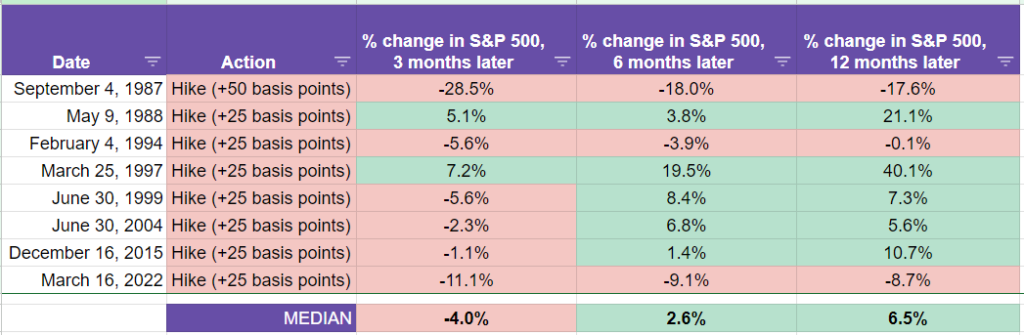
Historical data from the last 40 years illustrate that while the S&P 500 typically dips about 4.0% in the three months following an initial rate hike, the slump is short-lived. Within six months, the market completely erases those losses to sit up 2.6%, stretching into a 6.5% gain after a full year.
Central bankers rarely walk away after one move. History shows the Fed prefers a marathon over a sprint, usually embarking on a prolonged cycle where rates are adjusted incrementally over several months or years.
Nevertheless, even in rate hiking cycles, the market still often takes it in stride.
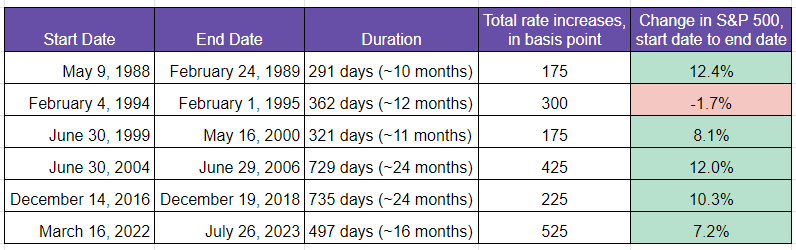
Over the past 40 years, the S&P 500 has posted positive returns between the first and last rate hike in all but a single instance.
So, why do rate hikes often accompany the feeling that the market will sell off?
Let’s compare the two cycles when rates increased the most over the last forty years – 2004 to 2006 and 2022 to 2023.
From 2004 to 2006, Alan Greenspan raised rates 17 consecutive times. Because he did it at a slow and predictable pace (+25 basis points every single meeting), the market kept rising, finishing in positive territory in 2004, 2005, and 2006.
By contrast, between 2022 and 2023, Jerome Powell didn’t just hike continuously to combat runaway inflation; he hiked aggressively (four consecutive +75 basis point hikes, and two +50 basis point hikes during that period). When continuous hikes happened at that speed, the market sold off, losing double-digit percentage points in 2022.
In other words, a fast and aggressive tightening cycle creates much greater short-term losses.
Anticipation of one single rate hike in September isn’t a reason to start selling stocks. However, if we are wrong and it leads to a sell off, it will represent a buying opportunity because losses are historically short-term and lost ground is recovered within months.
-written by Jeff Pollock
DISCLAIMER: The opinions expressed in this publication are for general informational purposes only and are not intended to represent specific advice. All publications have been written by a person other than the person that approved its distribution. No compensation has been received from any party to promote or publish this content. The views reflected in this publication are subject to change at any time without notice. Every effort has been made to ensure that the material in this publication is accurate at the time of its posting. However, Schneider & Pollock Wealth Management Inc. will not be held liable under any circumstances to you or any other person for loss or damages caused by reliance on information contained in this publication. You should not use this publication to make any financial decisions and should seek professional advice from someone who is legally authorized to provide investment advice after making an informed suitability assessment.